


 English
 русский




 Products CENTER


 Nov 27, 2026
 Industry News
Meltblown Filter Media: Structure, Filtration Performance, Applications, and Selection Guide
Capturing particles is only half of a filter's job. It also has to let air or liquid through at a workable rate. That is why choosing Meltblown Filter Media takes more than reading a material name or a thickness figure. Fiber structure, efficiency, pressure drop, polymer type, and operating conditions all shape the outcome. This guide is for engineers, product developers, and industrial buyers who need to assess Meltblown Nonwoven Fabric with confidence. It covers how the material is made, what drives its filtration performance, where it is used, and how to judge whether it fits your application.
What Is Meltblown Filter Media?
Meltblown Filter Media is a nonwoven filtration material. Molten polymer is pushed through tiny die openings, and a stream of high-velocity hot air stretches it into very fine fibers. The fibers cool, land on a moving collector, and form a web. That web can work as a filtration layer on its own or sit inside a multilayer filter.

The dense network of fine fibers gives particles many chances to touch a fiber and stay there. How well the media performs depends on its polymer, fiber characteristics, web structure, and any treatment applied during production.
How Is Meltblown Filter Material Manufactured?
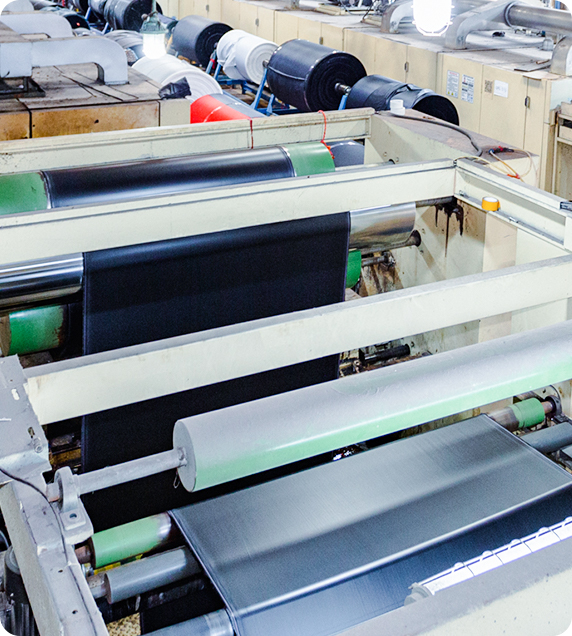
The process runs through five broad stages:
- Polymer melting: A thermoplastic polymer is heated until it flows through the extrusion system.
- Fiber formation: The melt is forced through small openings in a die.
- Air attenuation: Hot air at high speed draws the polymer streams into fine fibers. Process settings affect fiber diameter and distribution.
- Web formation: The fibers cool and settle on a moving collector as a randomly arranged web.
- Finishing and conversion: Depending on the end product, the web may be treated, inspected, slit, or converted into a filter component.
Polypropylene (PP) is the most common polymer for meltblown filtration. The final choice still depends on the application and the properties it demands. Polymer characteristics, air temperature, airflow, and extrusion conditions all leave their mark on the fiber structure.
How Does Meltblown Nonwoven Fabric Differ from Spunbond Fabric?
Both are nonwovens, but they form fibers differently and usually play different roles in a filter.
| Comparison factor | Meltblown Nonwoven Fabric | Spunbond Nonwoven Fabric |
| Fiber formation | Hot air draws molten polymer into fine fibers | Extruded polymer forms continuous filaments |
| Typical structure | Fine fiber network built around functional needs | Generally coarser continuous-filament structure |
| Common role in filters | Often the functional filtration layer | Often a support, strength, or protective layer |
| Performance considerations | Fiber fineness, web density, efficiency, pressure drop | Filament structure, strength, permeability, support |
Treat these as general tendencies, not fixed rules. Real properties depend on polymer choice, process conditions, web construction, and what the finished filter must do. Designers often pair the two: a meltblown layer filters, and a spunbond layer adds structure.
Features of Meltblown Filter Media
Meltblown media is popular for its fine fiber network and the design freedom of nonwoven construction. No single property settles suitability, though. Judge the material on filtration, flow, structure, and application fit together.
Fine Fiber Structure and Particle Capture
The process produces thin fibers that join into a connected web. That gives a large fiber surface for a small amount of material, so particles are more likely to meet a fiber and be held.
Several capture mechanisms can be at work: inertial impaction, interception, Brownian diffusion, and, where present, electrostatic attraction. Which one dominates depends on particle size, airflow, fiber diameter, and the material's electrostatic properties.
A fine structure does not guarantee a given rating. Verify performance with a suitable test method under conditions that match your use.
Filtration Efficiency
Filtration efficiency is the share of particles removed from a fluid stream under defined test conditions. It is a central measure when comparing media for air filtration or other particle separation.
Fiber diameter, web structure, thickness, basis weight, particle size, flow rate, and electrostatic treatment all influence it. With electrostatically treated media, the charge can boost capture without a much denser structure. How well that works depends on the treatment and on how the media is used.
When you read an efficiency claim, check four things: the test method, the target particle size, the flow conditions, and the reported figure. Results from different methods are not directly comparable.
Porosity, Air Permeability, and Pressure Drop
Porosity is the void space in a material. Air permeability is how easily air passes through under set conditions. Pressure drop is the pressure difference across the media as fluid flows through.
All three tie back to fiber diameter, thickness, density, and web structure. A change that improves capture can also raise flow resistance. The aim is a sensible balance for your system, not the highest efficiency or the lowest pressure drop in isolation.
For liquid filtration, evaluate flow under conditions that reflect the liquid's viscosity and the system's operating pressure.
Basis Weight and Thickness
Basis weight is mass per unit area. Thickness is the distance between the material's surfaces under specified measurement conditions.
Both describe the media, yet neither tells you how it will filter. Two webs with the same basis weight can differ in fiber diameter, fiber distribution, pore structure, and electrostatic behavior. A thicker web will not automatically filter better or flow more freely.
Read these numbers next to efficiency, permeability, mechanical integrity, and test data. A single physical measurement gives a thin picture.
Electrostatic Properties
Some meltblown materials are electrostatically treated to improve capture. In the right setting, charged or polarizable particles are drawn to fibers even if they would not collide with them directly.
This matters most in certain air filtration products. Not every meltblown product carries a charge, and performance varies with formulation, treatment method, and exposure conditions. Do not assume electret properties unless the specification or technical documents confirm them.
Mechanical Strength and Layered Construction
Filter media must hold together through handling, conversion, installation, and service. Depending on the job, that can mean tensile strength, dimensional stability, resistance to deformation, and compatibility with downstream processing.
Meltblown webs are often combined with other nonwoven layers or supports. A fine filtration layer backed by a spunbond layer is a typical example. The finished composite performs according to each layer and how they work together.
So decide strength and construction from the final filter design. The word "meltblown" alone tells you very little about either.
Common Applications of Meltblown Filter Media
Meltblown Nonwoven Fabric appears in many filtration products because its fiber structure can be tuned for different jobs. Whether a given material fits depends on its composition, construction, verified performance, and conditions of use.
- Air Filtration: In selected air filters, meltblown media acts as the particle-capturing layer. The fine fiber network helps trap airborne particles. Its structure, and any electrostatic treatment, set the balance between efficiency and airflow resistance. The right grade depends on target particles, required efficiency, air velocity, pressure-drop limits, and the testing standards that apply.
- Liquid Filtration: Some meltblown materials can serve in liquid filtration, provided their structure and chemical compatibility suit the system. Selection means looking at liquid composition, viscosity, suspended particles, operating pressure, and the result you need. Air filtration data cannot stand in for liquid testing. Assess performance under conditions that reflect your liquid and your filter design.
- Pre-Filtration and Multilayer Filter Structures: Meltblown layers can be built into composite media with supporting or protective layers. Each layer does a different job, and the final result depends on the whole structure. Pick supporting materials, layer order, and bonding method according to the finished product's filtration, flow, and mechanical needs.
- Industrial and Equipment Filtration: Selected meltblown materials may suit industrial filtration systems or equipment filter components. Suitability depends on the contaminants, operating conditions, maintenance needs, and the specifications of the finished filter.
These categories show where the material may be used. They do not promise that every meltblown product fits every one of them.
How to Select the Right Meltblown Filter Material
Begin with the filtration requirement, then work toward the material specification.
Step 1: Identify the filtration medium. Decide whether you are filtering air, gas, or liquid. This sets the basic testing and compatibility rules.
Step 2: Define the target contaminants. Pin down the type, size, and concentration of the particles you need to capture.
Step 3: Set the performance requirements. State the required efficiency, allowable pressure drop, flow rate, and other system limits. Use test methods that match your application.
Step 4: Compare material specifications. Look at polymer, basis weight, thickness, fiber structure, permeability, and mechanical properties where data exists.
Step 5: Check operating compatibility. Consider temperature, liquid chemistry where relevant, humidity, and any exposure that could change how the material behaves.
Step 6: Evaluate the complete filter design. If the media will be combined with supports or other components, judge the finished structure, not one layer.
Step 7: Verify the material under relevant conditions. Review the documentation and run sample or system tests where needed. Confirm the results meet your requirements before you lock in the specification.
Following these steps ties your choice of Meltblown Filter Media to measurable requirements. It keeps you from deciding on a product name alone.
Frequently Asked Questions
What Is the Difference Between Meltblown Filter Media and Spunbond Nonwoven Fabric?
Meltblown material forms when hot air draws molten polymer into fine fibers. Spunbond material forms from continuous filaments. Meltblown layers often handle filtration, and spunbond layers often add support and strength. The actual role of each depends on the product design and its specifications.
What Is Meltblown Filter Material Made Of?
Polypropylene is the most common polymer in meltblown filtration media. Other polymers may be used, depending on the process and the application. Confirm the exact composition of a specific product in its technical specifications.
What Factors Affect Meltblown Filter Media Efficiency?
Fiber diameter, web structure, basis weight, thickness, particle size, flow rate, and electrostatic properties all play a part. Test method and operating conditions matter as well. Read any efficiency claim together with its testing information.
Can Meltblown Nonwoven Fabric Be Used for Air and Liquid Filtration?
Some meltblown materials suit air filtration, and selected grades can be used for liquids. Suitability for one medium does not prove suitability for the other. Consider material compatibility, filtration requirements, flow conditions, and application-specific testing.
How Do You Choose Meltblown Filter Media for an Application?
Identify the filtration medium and the target contaminants. Then set the required efficiency, flow rate, pressure drop, and operating conditions. Compare available specifications, and verify your shortlisted material with relevant data and testing.
Does a Higher Basis Weight Always Mean Better Filtration?
No. Basis weight is mass per unit area, and it does not set efficiency or overall filter performance by itself. Fiber structure, pore characteristics, electrostatic properties, flow conditions, and test methods all affect the result.
Why Should Pressure Drop Be Considered Alongside Filtration Efficiency?
Pressure drop is the resistance fluid meets as it passes through the media. A material can capture particles well and still be wrong for the job if its resistance exceeds what the system can handle. Looking at both properties gives a more balanced specification.
Meltblown Filter Media pairs a fine nonwoven fiber structure with filtration characteristics that can be adjusted for different uses. Whether it suits your job depends on how it captures particles, how freely fluid passes through, how well it holds its structure, and how it behaves under real operating conditions. Once you understand how meltblown differs from spunbond, how efficiency trades off against pressure drop, and what the specifications actually mean, selection becomes far more systematic.
For professionals evaluating Meltblown Filter Material, the practical route is simple. Define the filtration requirements, compare documented specifications, and confirm performance under relevant conditions. Visit the Yongda-Tex Meltblown Filter Media product page to review the available product information and identify which specifications to confirm for your application.
 479067683@qq.com
 +86 - 512-63516211
 +86 - 15895525966
 Group 9, Qianzhuang Village, Shengze Town, Wujiang District, Suzhou City, Jiangsu Province, China
